


Logistics technology is often reduced to tools. That framing misses the point. It is the connective tissue that keeps global commerce alive, moving, and responsive under pressure.
The present supply chain system shows the current operational state because supply chains now operate according to their planned schedule. The operation depends on multiple systems which work together as one unified system. The system includes artificial intelligence which makes decisions and Internet of Things devices which gather data and automated systems which perform tasks.
The urgency is not theoretical. PwC says more than 40% of CEOs believe companies that do not reinvent their business models will not last another decade. That is not a tech problem. That is a survival problem.

This article breaks down what logistics technology actually means in 2026, the systems shaping it, and how they are quietly rewriting how supply chains operate.
The 4 Pillars of Logistics Technology in 2026
Most conversations around logistics technology stay at the surface. AI, automation, cloud. It sounds impressive but explains nothing. The real shift sits deeper. Four pillars are quietly reshaping how supply chains think, act, and recover.
A. Agentic AI and Machine Learning
AI is no longer sitting in dashboards waiting for humans to decide. It is acting.
Microsoft puts it directly. Supply chains have entered an ‘agentic era,’ where AI agents can reason, plan, and act across complex workflows, supported by digital twin style simulations.
That changes the entire equation. Earlier, AI predicted delays. Now it reroutes shipments before delays hit. Earlier, systems flagged risks. Now they mitigate them in real time.
The uncomfortable truth is most companies still use AI like a reporting tool. That gap between capability and usage is where competitive advantage is being created.
B. The Industrial IoT Mesh
Visibility used to mean tracking shipments. Today it means understanding conditions, context, and consequences in real time.
The Industrial IoT layer is doing that quietly. Smart containers, sensors, and connected devices are turning static supply chains into living systems.
Google Cloud reports a case where supply chain visibility improved from 10% to country level visibility using 75 GB of data across 4,000 data points.
That jump is not cosmetic. It changes how decisions are made. When you know where things are, you react. When you understand what is happening across nodes, you act ahead of time.
This is where logistics technology starts becoming intelligence infrastructure, not just tracking infrastructure.
C. Pragmatic Automation and Robotics as a Service
Automation used to be expensive, rigid, and reserved for large enterprises. That model is breaking.
Robotics as a Service is changing the economics. Instead of heavy upfront investments, companies can now deploy automation in a modular and scalable way.
Warehouses are becoming adaptive systems. Robots handle repetitive work. Humans focus on exceptions and decision making.
But there is a catch most people ignore. Automation does not fix broken processes. It amplifies them. If the workflow is inefficient, automation will scale inefficiency faster.
That is why pragmatic automation matters more than aggressive automation. It is not about replacing humans. It is about designing systems where both can operate at their strengths.
D. The Digital Twin
The digital twin serves as the main concept that describes proactive supply chains.
A digital twin establishes a virtual replica which reflects all aspects of the supply chain system. The system models all elements of the system including every node and every movement and every constraint in real time.
The system lets companies create simulations of future scenarios which they can test before the actual events take place. Port strike, supplier failure, demand spike. Instead of reacting, they test outcomes and choose the best path.
Also Read: How Does Solar Energy Work and Why Is It the Fastest-Growing Renewable Power Source in 2026?
The mistake many companies make is treating digital twins as visualization tools. They are not. They are decision engines.
When combined with agentic AI, digital twins move from simulation to execution. That is where logistics technology stops being supportive and starts becoming strategic.
Transforming the Supply Chain from Visibility to Resilience
Visibility was the goal a few years ago. It is no longer enough. Knowing what is happening does not solve anything unless action follows.
The focus in 2026 is resilience. The ability to absorb shocks, adapt quickly, and keep operations running.
Warehouse Excellence
Warehouses are no longer static storage units. They are dynamic environments constantly reconfiguring themselves.
Generative AI is playing a role here. It analyzes demand patterns, inventory movement, and constraints to continuously re slot products.
Fast moving items move closer to dispatch zones. Slow moving inventory gets pushed back. The layout evolves daily, not annually.
This reduces picking time, improves accuracy, and increases throughput without expanding physical space.
However, the real shift is not efficiency. It is adaptability. Warehouses are no longer optimized for average demand. They are optimized for volatility.
Last Mile Optimization
The last mile has always been the most expensive and unpredictable part of the supply chain. That has not changed. What has changed is how it is being managed.
Micro fulfillment centers bring inventory closer to demand zones which results in faster deliveries and simpler transportation operations.
The process of route optimization has reached a point where it now requires real-time decision-making capability together with advanced intelligence systems.
Amazon Web Services provides a practical demonstration of this concept. The implementation of route optimization resulted in total cost reductions of 24%, decreased mileage by 22%, and increased vehicle utilization from 81% to 96% according to the study results. Planning time dropped from hours to minutes per distribution center.
That is not incremental improvement. That is structural efficiency.
The deeper insight here is simple. Optimization is no longer periodic. It is continuous. Routes are not planned once. They are constantly recalculated based on real time conditions.
That is what turns visibility into resilience.
The Technology Driven Green Mandate
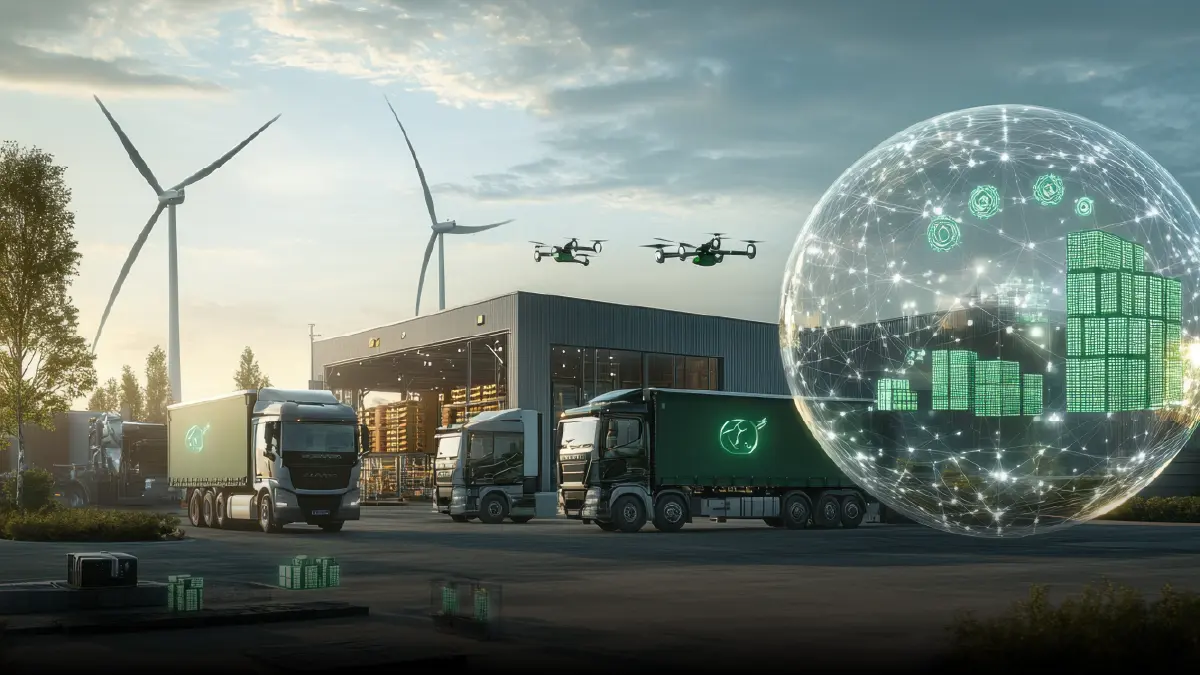
Sustainability in logistics used to be a reporting exercise. It is becoming an operational priority.
The pressure is coming from regulators, customers, and cost structures. But the real enabler is technology.
Circular Logistics
Reverse logistics has always been messy. Returns, recycling, refurbishing. Most companies treated it as a cost center.
That thinking is being challenged.
McKinsey & Company points out that redesigning reverse logistics with AI and automation can convert 200 billion dollars in annual costs into business value.
That flips the narrative completely. Circular logistics is no longer about compliance. It is about opportunity.
Technology is making this possible. AI sorts returns faster. Automation handles processing. Analytics identifies reuse potential.
What was once waste being now a value stream.
Carbon Transparency
Another shift is happening quietly. Carbon is becoming measurable at a granular level.
Blockchain and digital product passports are enabling traceability across the supply chain. Companies can now track emissions at product level, not just company level.
This matters because transparency drives accountability. And accountability drives change.
The challenge is not technology. It is integration. Carbon data sits across systems. Bringing it together in a usable format is still a work in progress.
But once that is solved, sustainability stops being a separate initiative. It becomes embedded in every decision.
How to Future Proof Your Tech Stack?
Knowing what logistics technology can do is one thing. Making it work is another.
Most failures do not happen because of bad technology. They happen because of poor implementation.
Step 1: Data Hygiene
Everything starts with data. And most data are messy.
The AI systems require data that is clean and structured and reliable for their functions. All outputs lose their reliability when this essential component is missing.
The phrase garbage in, garbage out still holds. In fact, it matters more now than ever.
Companies often rush to deploy AI without fixing data pipelines. The results become unsatisfactory while trustworthiness suffers.
Fixing data is not glamorous. But it is foundational.
Step 2: Interoperability
Legacy systems are one of the biggest bottlenecks in logistics.
Disconnected platforms create silos. Data does not flow. Decisions get delayed.
The shift is towards API first, cloud based platforms that can integrate easily.
Interoperability is not a technical luxury. It is an operational necessity.
When systems talk to each other, supply chains become coordinated. When they do not, inefficiencies multiply.
Step 3: Human Machine Orchestration
Technology does not replace people. It changes how they work.
AI agents can handle routine decisions. Humans handle exceptions, strategy, and judgment.
That requires a different skill set. Employees need to understand how to work with systems, not just operate them.
Upskilling becomes critical. Not as a one-time effort, but as a continuous process.
Companies that ignore this end up with advanced systems and underprepared teams.
That gap is where most transformation efforts fail.
Leading the Next Era of Logistics

The conversation around logistics technology often focuses on capability. That is the wrong focus.
The technology already exists in its current form. The actual limitation of the system exists through its current state of operational availability.
The companies that will achieve victory in 2026 will win through their ability to combine multiple tools. The companies that win will achieve success through their capacity to combine their tools with business objectives and maintain operational success.
Supply chains face their main challenge in their ability to convert insights into actual business operations.
Companies need to improve their operational processes through better utilization of their current technology systems.
The next stage of logistics development will establish its future direction at that location.