



This is a time when electronics and embedded systems are experiencing a significant technological shift. As a result of the explosive development of smart home appliances, robots, drones, medical diagnosis solutions, and automotive HMIs, electronic hardware engineers are confronted with a very challenging problem – providing low-latency, private AI inference at the level of local edge hardware without exceeding its power budget and design cycle.
Traditionally, running computer vision, speech recognition, and sensor fusion algorithms involved the use of raw sensor telemetry data streaming to cloud data centers on a hyperscale.
Nevertheless, cloud-centric architecture involves many operational challenges including the issue of high latency, expensive bandwidth costs, potential risk of losing connection, and data privacy compliance issues under GDPR and other global regulations.

To address the mentioned challenge, semiconductor manufacturers created edge AI NPUs.
Yet, hardware developers encountered another barrier-fragmented software development kits (SDKs) and the lack of standardized development platforms that bridge initial evaluation to high-volume manufacturing.
Without accessible development kits, engineering teams spend months building custom carrier boards rather than deploying market-ready edge AI products.
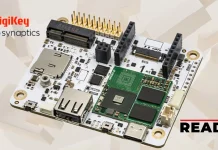
Addressing this hardware prototyping bottleneck, semiconductor innovator Synaptics Incorporated, in collaboration with Google Research, announced the general availability of the Synaptics Coralboard™ Edge AI Development Board, available exclusively through global electronics distributor DigiKey.
Manufactured by embedded system specialist Grinn, the Coralboard platform pairs Synaptics’ Astra™ SL2619 embedded processor with Google Research’s Coral NPU technology, providing hardware designers and original equipment manufacturers (OEMs) with an integrated hardware and software kit engineered for rapid edge AI prototyping.
Bridging Low-Power Silicon with Coral NPU Hardware Acceleration
The exclusive distribution agreement between Synaptics and DigiKey makes the Coralboard platform accessible to engineers and enterprise procurement managers worldwide. Built around the Grinn AstraSOM-261x System-on-Module (SoM), the Coralboard SL features Synaptics’ Astra SL2619 processor-housing dual 2 GHz Arm® Cortex®-A55 cores, a Cortex-M52 real-time coprocessor, and the 1 TOPS Torq™/Coral NPU engine-backed by 2 GB DDR4 memory.
Key technical and operational pillars of the launch include:
Exclusive DigiKey Distribution Channel: Provides instant global availability, complete datasheets, evaluation kits, and 24/7 technical support via DigiKey‘s developer forums.
1 TOPS Integrated Torq/Coral NPU Engine: Features Google Research’s Coral NPU integrated into Synaptics’ Torq AI architecture for low-power, high-efficiency machine learning inference.
Extensible Modular Expansion Capabilities: Incorporates standard QWIIC and mikroBUS connectors alongside add-on HATs for HDMI, power delivery, dual cameras, digital microphones, and M.2 wireless modules.
Also Read: Hitachi Energy and Rockwell Automation Partners on Power and Automation for Industrial Electrification
Defragmented Astra SDK Software Stack: Supports Linux-based development, open-source TensorFlow Lite models, and Synaptics’ Torq Edge AI compiler.
“The Coralboard provides users and OEMs a faster path to building and deploying at-scale AI products for the edge,” stated Vikram Gupta, Senior Vice President and General Manager at Synaptics.
Impact on the Electronics Industry
The commercial release of the Coralboard through DigiKey highlights major developments across the broader Electronics landscape:
1. Shifting from Cloud Compute to Standardized On-Device Intelligence
For over a decade, embedded electronics relied on microcontrollers for basic I/O and cloud gateways for complex computation. Commercializing the Coralboard formalizes the electronics industry shift toward Universal Edge AI Processing. Integrating 1 TOPS neural processing directly onto development boards allows product designers to deploy real-time object detection and acoustic anomaly sensing locally.
2. Defragmenting the Hardware Developer Ecosystem via Global Distribution
Historically, specialized AI silicon has lacked wide availability in terms of distribution channels, thus limiting development kits only to tier one tech conglomerates. Collaboration with DigiKey only confirms that Democratized Component Access Accelerates Hardware Innovation. Global distribution makes possible for small-to-medium-size OEMs, university researchers, and IoT startups to buy SoMs for production with prompt delivery.
Overall Impact on Businesses Operating in the Industry
From the perspective of original design manufacturers (ODMs), industrial automation leaders, robotics engineers, and electronic components suppliers, there are definite benefits from Synaptics-DigiKey collaboration:
Reducing Hardware Time-to-Market: Already pre-certified SoMs and plug-and-play expansion HATs decrease hardware prototyping from years to just weeks.
Reducing Total Cost of Ownership (TCO): Inference locally removes the cost of ongoing cloud API calls and reduces cellular data requirements for devices.
De-Risking Mass Production: Prototyping using production-grade Grinn AstraSOM hardware facilitates the process from evaluation to manufacturing.
Conclusion
Synaptics’ release of the Coralboard Edge AI development board, powered by Google Coral NPU technology and distributed exclusively through DigiKey, represents an important milestone in the evolution of embedded computing, semiconductor distribution, and edge AI design. By pairing Synaptics’ Astra processors with Google’s neural inference technology and DigiKey’s global logistics network, these industry leaders deliver a practical blueprint for next-generation hardware. For the global electronics industry, this news confirms that the future of smart devices relies on accessible, low-power, and standardized edge computing platforms.