




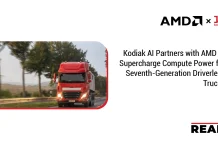
Kodiak AI, has joined forces with semiconductor giant AMD to integrate AMD EPYC™ Series processors into its seventh-generation autonomous truck architecture.
The integration establishes Kodiak as the first autonomous vehicle company to deploy AMD’s server-grade EPYC processors directly into production-grade hardware designed for driverless trucking. The deployment addresses the massive processing demands required to aggregate, clean, and analyze high-volume real-world sensor streams, enabling the company’s autonomous driving system-the Kodiak Driver-to safely navigate complex freight environments.
Overcoming the “Physical AI” Data Bottleneck

Deploying autonomous vehicles onto public highways requires continuous, ultra-low-latency processing of massive data streams generated by onboard LiDAR units, optical camera arrays, and radar sensors. Within Kodiak’s seventh-generation system, AMD EPYC CPUs serve as the primary computing engine, performing critical task orchestration, sensor data preprocessing, and real-time path planning.
Also Read: AIR and Elmo Motion Control Partner to Enhance Payload Efficiency for Uncrewed Heavy Lift Cargo Aircraft
Because key autonomous driving tasks-such as localization and immediate path routing-are latency-sensitive and cannot be easily parallelized across traditional graphic units, high-performance central processing units (CPUs) are vital. The elevated clock speeds and power efficiency of the AMD EPYC architecture allow the Kodiak Driver to execute complex AI models without exceeding vehicle thermal and power limits.
“Physical AI is pushing computing into some of the most complex and data-intensive environments in the world,” said Wayne Lyons, senior director, Automotive Market, AMD. “Kodiak is demonstrating what’s possible when advanced autonomous driving software is paired with high-performance AMD compute. Together with Kodiak, AMD is providing the processing capabilities needed to move driverless trucking from innovation to significant scale.”
“Physical AI requires compute capabilities that can rapidly handle enormous amounts of sensor data while supporting increasingly sophisticated AI workloads,” said Don Burnette, Founder and CEO, Kodiak. “AMD delivers best-in-class CPU technology with the performance, scalability and efficiency required for advanced autonomous driving applications. AMD EPYC CPUs give us the compute capabilities we need to advance the Kodiak Driver and continue commercializing autonomous trucking.”
Scaling Autonomous Freight Operations
The hardware integration represents a significant step forward in Kodiak’s roadmap to commercialize driverless long-haul freight operations at scale. By leveraging AMD’s high-efficiency computing stack, Kodiak is strengthening the reliability, processing throughput, and safety boundaries of its autonomous fleet.