


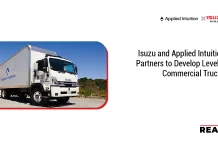
Applied Intuition and Isuzu Motors Limited started to use a second generation of autonomous trucks on a 400-kilometer logistics corridor in Japan. It brought the level of technology closer to a real-world implementation of Level 4 driverless freight operations.
The autumn shipment of autonomous trucks to real-world logistic production is a continuation of the companies’ ongoing partnership. Back in 2015, the two parties ran driver-autonomous trucks on public roads in Japan. This time the upgraded hardware and software are used along with running the operations on a more complex hub-to-hub routean important milestone in their joint dream of safe, fully autonomous trucking.
The project also tackles a major logistics challenge in Japan, termed the “2024 Problem, ” which predicts that the number of truck drivers will fall by about 36% by 2030. It is a serious threat to the supply chain security so automation will be the only way to keep the freight functioning efficiently.

“Autonomous trucking will play a critical role in the future of logistics in Japan,” says Masanori Katayama, CEO of Isuzu Motors Limited. “Through our partnership with Applied Intuition, I feel confident Isuzu can pioneer autonomous driving for commercial vehicles in Japan, as the collaboration combines our deep expertise in commercial vehicles with Applied Intuition‘s advanced autonomy software and data capabilities. Time and again, I’m amazed at the depth and breadth of Applied’s technical capabilities. Together, we are building a scalable foundation for the next generation of logistics operations.”
Also Read: Columbus and COSMO Partners to Accelerate Digital Transformation in Waste Management
Second-Generation Autonomous Trucks Designed for Real-World Complexity
Engineered collaboratively, the new generation of trucks represents a leap forward in autonomous vehicle performance and scalability. Unlike traditional highway-focused autonomy, the expanded hub-to-hub operations introduce more complex and dynamic driving conditions.
These vehicles are equipped with improved sensor and computer technologies that help to enhance awareness, redundancy, and safety. The vehicles are intended to operate effectively in a range of situations, including electronic toll collection (ETC) gates, intersections, traffic signals, pedestrian zones, mixed traffic situations, and low-speed logistics centers, while also ensuring high-speed capabilities on the highway.
At the core of the system is Applied Intuition’s end-to-end autonomy model, powered by a continuous data engine. This architecture enables constant learning by integrating real-world driving data with large-scale simulation environments. Scenarios encountered during live operations are replicated in simulation, allowing engineers to refine algorithms, validate improvements, and redeploy optimized models across the fleet.
“Autonomy is ultimately about creating systems that learn from the physical world,” says Qasar Younis, CEO of Applied Intuition. “What we’re building with Isuzu is a system that improves every time it operates. Every route, every edge case, every mile feeds back into the model. That’s how you turn autonomy from a technical milestone into something the logistics industry can depend on.”
Expanded Daily Operations Across Key Logistics Route
Starting from building on deployments made earlier along the Shin-Tomei Expressway and within logistics terminals, autonomous trucks will now run daily over an extended 400-kilometer route between Tochigi and Aichi prefectures. These vehicles will move commercial cargo, which will allow the autonomous systems to be tested in ongoing real-world freight operations.
System gets safer, more reliable and efficient not only through daily operations in diverse and challenging environments but also thanks to each mile driven that adds to enhancement of both real-world performances and simulation developments.
Solving Japan’s Logistics and Workforce Dilemmas
Aside from technology advancement, this deployment is also a strategic move to address Japan’s changing logistics and workforce issues. As a matter of fact, close to 84% of truck drivers suffer from health problems related to overwork.
If this problem is not addressed, the future shortage of drivers is seen to affect the logistics industry significantly. Autonomous trucking is a sure way to move forward, ensuring that the transportation of goods is consistent while improving the efficiency and sustainability of the operation.