



The global landscape of automotive and intelligent transportation is witnessing a paradigm shift towards new architecture. With exponential developments taking place in AI, sensor fusion, and software-defined vehicles (SDVs), automakers around the world are shifting from basic driver assistance towards fully autonomous level 3 and level 4 driving. But as vehicle intelligence moves from stand-alone ECUs to central AI super computers, OEMs face an extremely difficult physical problem in terms of thermal management, power density, and integration constraints.
Modern autonomous driving systems need to continuously process large volumes of telemetry from the surroundings in terms of cameras, radars, optical LiDAR sensors, and ultrasonic sensors.
For multi-sensor fusion and real-time path planning, on-board AI computing systems use hundreds of watts of power within constrained space of a vehicle chassis.

Insufficient thermal management or low-efficiency in power conversions result in overheating and hardware failures during critical driving actions.
To make advanced autonomous driving practical, car makers need integrated power electronics, thermal management, and sensors designed together on an AI reference architecture.
Addressing these foundational engineering bottlenecks, global power management leader Delta Electronics announced a major technological expansion: developing next-generation autonomous driving systems built directly on the NVIDIA Hyperion™ platform.
By combining Delta’s expertise in automotive-grade power conversion, advanced liquid cooling, and precision sensor packaging with NVIDIA’s high-performance AI compute stack, the initiative provides global automakers with a validated hardware infrastructure designed to accelerate the commercialization of software-defined autonomous vehicles.
Uniting Automotive Power Electronics with NVIDIA Hyperion
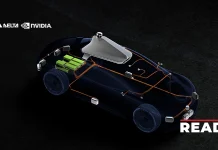
The development milestone establishes an integrated hardware control plane engineered specifically for high-density autonomous driving compute clusters. Utilizing NVIDIA Hyperion-the production-ready reference architecture for autonomous vehicle development-Delta integrates its specialized automotive-grade power electronics, advanced thermal management, and precision camera and sensor modules into a cohesive platform.
Key technical and operational pillars of the announcement include:
Production-Ready NVIDIA Hyperion Integration: Co-engineers specialized power distribution modules, sensor harnesses, and thermal interfaces built to support NVIDIA’s centralized AI drive domain controllers.
Automotive-Grade Power Delivery: Deploys Delta’s high-efficiency DC/DC converters and power management systems to deliver stable voltage to high-throughput AI processors under extreme vehicle operating conditions.
Advanced Liquid and Thermal Management: Integrates custom liquid cooling coldplates, micro-channel heat exchangers, and automotive fans to dissipate high thermal loads from AI compute engines.
Also Read: Sidus Space Consolidates LizzieSat-4 and LizzieSat-5 Dual Launch on SpaceX Bandwagon-6
Precision Sensor Modules: Incorporates Delta’s camera perception modules and sensor packaging technologies engineered to withstand extreme vibration, moisture, and thermal stress.
“As vehicles evolve into intelligent, software-defined platforms, the demand for high-performance AI compute combined with advanced power and thermal management has never been higher,” stated executive leadership at Delta Electronics.
Impact on the Automotive Industry
Delta Electronics‘ advancement of autonomous driving hardware built on NVIDIA Hyperion highlights major developments across the broader Automotive landscape:
1. Shifting from Bespoke Hardware R&D to Standardized Platforms
Historically, global automakers attempted to engineer custom power supply boards, cooling channels, and ECU enclosures independently, spending hundreds of millions of dollars on duplicate hardware R&D. Delta’s deployment on NVIDIA Hyperion formalizes the transition toward Standardized Autonomous Compute Foundations. Automakers can adopt pre-validated power and thermal solutions, allowing OEMs to focus software R&D on brand-differentiating driving features.
2. Solving the “Thermal-Power Barrier” for Centralized SDVs
As software-defined vehicles replace dozens of distributed ECUs with centralized supercomputers, power consumption and thermal dissipation become primary vehicle design constraints. Delta’s advanced liquid cooling and high-efficiency power conversion establish Thermally Resilient Vehicle Architectures. Guaranteeing continuous thermal dissipation prevents compute throttling during demanding edge cases.
Overall Effects on Businesses Operating in the Sector
For commercial automakers, Tier-1 system integrators, autonomous fleet operators, and automotive semiconductor vendors, Delta’s partnership with NVIDIA offers clear strategic advantages:
Shortening Vehicle Time-to-Market: Pre-validated power, thermal, and sensor integration drastically compresses the engineering phase for new autonomous vehicle platforms.
De-Risking Supply Chain Scale: Leveraging Delta’s global automotive-grade manufacturing footprint ensures reliable, high-volume production of complex power and cooling assemblies.
Lowering Total Cost of Ownership (TCO): High-efficiency power electronics reduce auxiliary electrical drag, preserving vehicle battery range and extending operational uptime.
Conclusion
Delta Electronics’ development of next-generation autonomous driving systems built on NVIDIA Hyperion marks a vital milestone in the evolution of software-defined vehicles and intelligent transportation. By pairing Delta’s power management and thermal engineering capabilities with NVIDIA’s high-performance AI platform, these industry leaders are providing a practical blueprint for autonomous mobility. For the global automotive industry, this news confirms that achieving safe, scalable autonomous driving requires building fast, energy-efficient, and thermally resilient physical foundations.