





Ten years back, EV charging royalty meant searching for a charger and hoping it worked. Nowadays, the speed of the global energy transformation is determined by it.
EV charging is not just about plugging in a car. It is the backbone of electric mobility. It connects transport, power grids, policy, and private capital into one operating system. If this layer fails, adoption slows. If it scales, everything accelerates.
And scale is already visible. Public EV charging points worldwide have more than doubled since 2022, reaching over 5 million public chargers by 2024. That is not early experimentation. That is infrastructure maturity.

This is why 2026 feels different. Networks are expanding. Standards are converging. Investment is rising. The question is no longer whether EV charging will scale. The real question is how intelligently and how fast it evolves from hardware deployment to energy architecture.
Decoding the Basics of EV Charging in 2026
Before we talk about scale, let’s simplify the foundation.
At its core, EV charging is the process of transferring electricity from a power source to a vehicle battery. However, the way that transfer happens matters.
There are two main types. AC charging and DC charging.
AC charging uses alternating current from the grid. The car converts it into DC inside the vehicle. This is slower but practical for homes and workplaces.
DC fast charging bypasses the onboard converter. It sends direct current straight to the battery. That is why DC fast charging stations can refill batteries dramatically faster.
Now, here is where it gets interesting. Charging is no longer just about speed. It is about compatibility.
The North American Charging Standard, widely known as NACS, has gained dominance across the United States. Meanwhile, CCS connectors remain widely used globally. What changed in 2026 is not just the hardware. It is interoperability. Networks are adopting both standards to reduce friction for drivers.
For example, EVgo plans to deploy 500 plus NACS stalls by the end of 2026. That is not a minor adjustment. That is a strategic shift toward standard alignment. When public networks adopt NACS at scale, it signals industry convergence, not fragmentation.
Let’s break charging levels down simply:
Level 1
Basic home charging using a standard outlet. Slow but reliable. Best for overnight charging.
Level 2
Common in homes, offices, and public spaces. Faster AC charging. Ideal for daily use.
Level 3
DC fast charging, including ultra-fast chargers. Designed for highways and high turnover zones.
Today, Level 3 is not niche. It is becoming the expectation on major corridors. And that shift changes how we design EV charging infrastructure across cities and highways.
The 2026 Evolution Beyond the Plug
Now let’s move past the basics.
Ultra-fast charging is rewriting user behavior. We are talking about 350 kilowatt stations that can deliver up to 80 percent charge in under 15 minutes, depending on vehicle compatibility. That changes psychology. Instead of planning around charging time, drivers begin treating it like a coffee stop.
However, speed alone does not define progress. Distribution does.
In 2026, EV charging infrastructure planning is no longer reactive. It is predictive. Operators analyze traffic patterns, dwell time, and retail density before installing chargers. Therefore, site selection now blends urban planning with data science.
Also Read: What Is a Digital Transformation Strategy for B2B and How Can It Drive Growth in 2026?
At the same time, wireless inductive charging is stepping out of laboratories and into commercial fleets. Park and charge pads are being deployed for logistics fleets and premium SUVs in controlled environments. No cables. No manual connection. Just alignment over a charging pad embedded in the ground.
Is it mainstream yet. No. But it signals direction. Charging is becoming frictionless.
More importantly, infrastructure evolution is not just technical. It is behavioral. When ultra-fast EV charging becomes reliable, range anxiety drops. When wireless pads reduce friction, adoption resistance drops. When networks align on standards, confusion drops.
The evolution in 2026 is about removing excuses.
Because here is the uncomfortable truth. For years, EV critics used charging gaps as the safety net for skepticism. That safety net is shrinking fast.
Public and Private Networks Powering the Growth Engine
Infrastructure does not scale on idealism. It scales on partnerships.
Governments stepped in through programs like NEVI in the United States and AFIR in the European Union to fill charging deserts. These frameworks set minimum coverage requirements along highways and urban centers. As a result, private operators gained clarity. When policy reduces uncertainty, capital follows.
Retail integration adds another layer. Big box retailers, grocery chains, and coffee chains have quietly become charging hubs. The logic is simple. Drivers spend 15 to 40 minutes on site. That dwell time converts into retail revenue. Charging becomes a customer acquisition tool.
Now look at execution.
EVgo operates 1,100 plus fast charging locations across 47 US states, with approximately 4,590 DC fast charging stalls as of late 2025. That footprint is not symbolic. It shows geographic reach and operational commitment.
This is what maturity looks like. Public funding de risks expansion. Private operators deploy at scale. Retail hosts monetize foot traffic. The ecosystem reinforces itself.
And when ecosystems reinforce themselves, EV charging stops being an experiment. It becomes infrastructure.
Sustainability and the Grid Connection
If EV charging only increased electricity demand, the grid would struggle. Therefore, the next evolution focuses on integration.
Global investment in EV charging infrastructure in 2024 reached roughly USD 39 billion, up about 27 percent from prior years, with roughly 75 percent allocated to public charging networks. That scale of investment signals long term confidence. Investors do not commit billions to temporary trends.
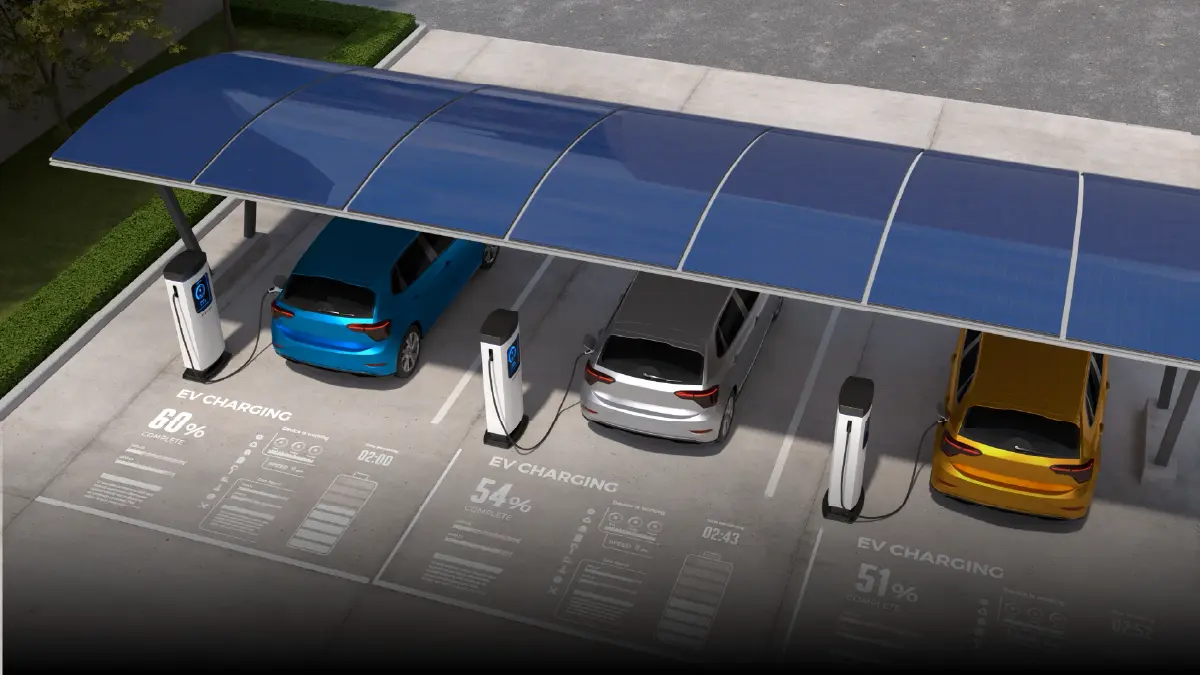
However, investment alone does not solve grid stress. That is why solar powered charging hubs and onsite battery energy storage systems are gaining traction. When a charging station integrates solar panels and battery storage, it can buffer peak demand. Instead of drawing maximum load from the grid instantly, it smooths consumption.
Then comes vehicle to grid technology, often called V2G. This is where things get strategic.
In a V2G setup, an EV can send stored energy back to the grid during peak demand. So your car becomes an energy asset, not just a consumer. During peak hours, aggregated EV fleets can stabilize grid fluctuations. That transforms EV charging from load problem to flexibility solution.
Now pause and think. Charging infrastructure is no longer isolated hardware on a parking lot. It is part of distributed energy architecture.
That is the real evolution of 2026.
Preparing for an All Electric Future
So where does this leave us.
Infrastructure used to be the question mark hanging over electric mobility. Not anymore. With millions of public chargers deployed, billions invested, networks expanding across states and countries, and standards aligning, EV charging is moving from constraint to catalyst.
Of course, challenges remain. Rural gaps persist. Grid modernization must continue. However, the narrative has shifted. We are no longer debating whether EV charging infrastructure will scale. We are debating how intelligently it will scale.
The upcoming 2030 period and the projected achievement of 100 million electric vehicles worldwide will establish new criteria for evaluation. The assessment will concentrate on four main areas which include operational performance and system compatibility and sustainable energy integration and power grid strength.
EV charging is no longer background infrastructure. It is strategic infrastructure. And in 2026, that realization is finally catching up with reality.