




The factory floor functions as a machine operation space which requires human supervision in 2026. The facility has transformed into a self-operating system. The system records data through all movements and vibrations and operational delays. The process of decision-making has shifted from waiting until the end of the day to operate in real-time without human intervention.
The smart factory concept transforms from a popular term into its actual implementation at this location. A smart factory operates as an advanced production system which integrates Internet of Things devices, artificial intelligence technology, robotic systems, and real-time data processing networks to function as a single unified intelligence system. Sensors capture what is happening. Software understands why it is happening. Machines respond before problems surface. Humans step in where judgment still matters.
Until recently, most factories focused on being connected. Machines talked. Systems synced. Dashboards lit up. In 2026, the shift is deeper. Factories are moving from connected to autonomous.

This is not theoretical. According to recent enterprise surveys, 56% of manufacturing executives are already using AI agents to drive operations and autonomous workflows. The current statistic shows which direction this situation is developing. The smart factory is no longer optional infrastructure. It is becoming the default operating model.
The anatomy of intelligence
A smart factory does not rely on one technology. It works because several systems evolve together. Remove one, and the intelligence collapses.
IIoT as the nervous system
Industrial IoT is no longer about basic sensors sending temperature or pressure readings. That phase is done. In a smart factory, intelligence moves closer to the product itself.
Components, pallets, tools, and even individual units now carry identity and context. They know where they are, what stage they are in, and what conditions they need. This item-level intelligence allows factories to stop thinking in batches and start thinking in flows.
As a result, decisions are not made at the top of the system anymore. They are distributed. If a component detects deviation, the system reacts locally instead of escalating everything upstream.
Edge AI as the brain
Cloud analytics helped factories see patterns after the fact. Edge AI changes the timing of intelligence.
Instead of sending raw data to the cloud and waiting for responses, smart factories process data at the machine or line level. Vision systems catch defects instantly. Motion systems adjust paths on the fly. Quality decisions happen in milliseconds.
This matters because manufacturing does not forgive latency. A delayed decision can mean scrap, downtime, or safety risk. Edge AI brings thinking closer to action, which is why it sits at the core of modern smart factory design.
Also Read: What Is Green Hydrogen and Why Is It Critical to the Clean Energy Transition in 2026?
The scale of this shift is already visible. 37% of manufacturers have deployed more than ten AI agents across their operations. That tells you this is not one smart algorithm running in isolation. It is many small brains coordinating across the factory.
Digital twins and the industrial metaverse
Digital twins are not fancy 3D visuals anymore. They are live operational mirrors.
In a smart factory, the digital twin updates as machines run, parts move, and constraints change. Engineers test changes virtually before touching the physical line. Bottlenecks are simulated. Stress points are exposed without shutting anything down.
This is also why industrial compute is becoming critical infrastructure. NVIDIA’s move to build the world’s first Industrial AI Cloud is not about branding. It signals that simulation, robotics, and industrial AI workloads now require dedicated, high-performance environments.
When factories can simulate reality before changing reality, risk drops sharply. That alone reshapes how fast manufacturing can evolve.
Cobots and autonomous mobile robots
Robots in smart factories are no longer isolated cages of automation. They are adaptive collaborators.
Cobots adjust to human movement. AMRs reroute themselves when pathways change. Learning happens continuously. Instead of rigid programming, behavior evolves based on context.
The result is flexibility. Production lines stop being frozen structures and start behaving like modular systems. This is one of the clearest signals that the smart factory is built for change, not just efficiency.
Why output is no longer the main metric
Traditional factories chased utilization. Smart factories chase flow.
Self-optimizing operations sit at the center of this shift. AI models continuously scan for micro-delays, quality drift, and energy inefficiencies. They flag problems before operators feel them. In some cases, they fix issues automatically.
Maintenance also changes shape. Predictive maintenance asked when a machine might fail. Prescriptive maintenance goes further. It tells teams what action to take, when to take it, and what happens if they wait.
This is not abstract improvement. Real-world deployments show that factories using AI, robotics, and digital twins have achieved productivity gains between 50 and 69 percent. Lead times dropped by 40 to 67 percent in some plants.
Those numbers matter because they come from complex environments, not controlled labs. They show what happens when intelligence is embedded into operations instead of layered on top.
The smart factory does not just make production faster. It makes it calmer. Fewer surprises. Fewer firefights. More predictable outcomes.
Smart factories in semiconductors and electronics
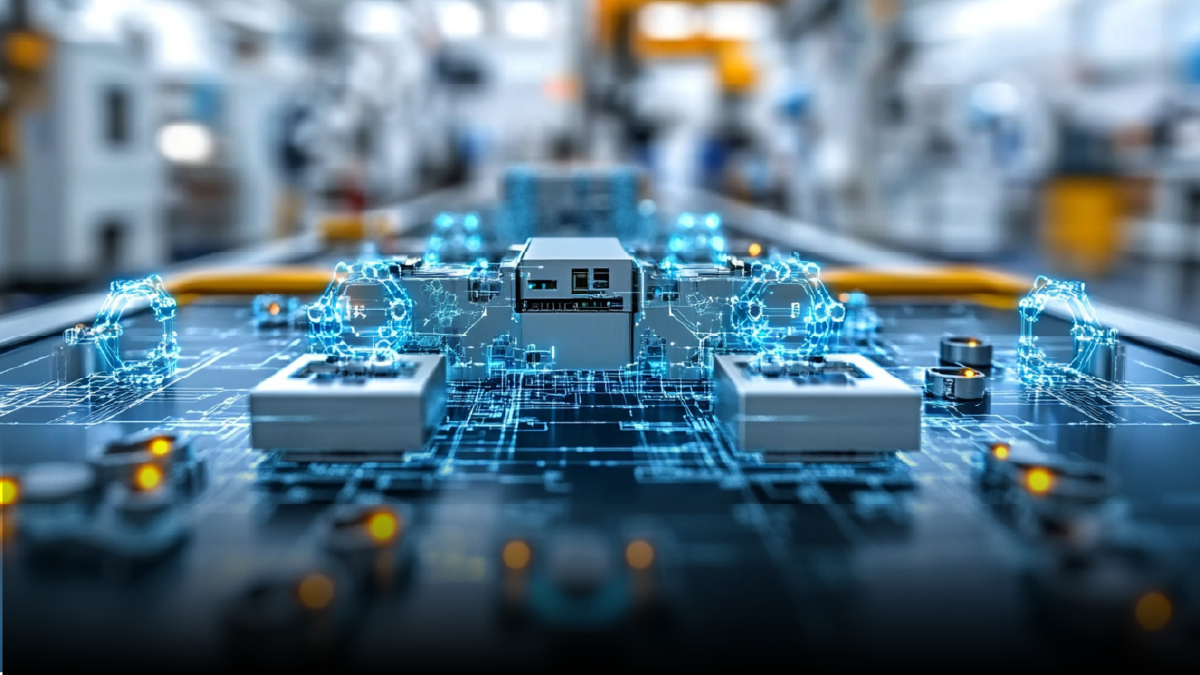
If there is one sector where smart factories are not a choice, it is semiconductors and electronics.
Chip fabrication operates at scales humans cannot perceive. Nanometers matter. Microscopic defects can destroy yields. Variability is the enemy.
Smart factory systems thrive here because complexity is constant. Computer vision inspects wafers for defects invisible to the human eye. AI models correlate process parameters across hundreds of steps. Digital twins simulate entire fabs before new recipes go live.
Yield optimization becomes a continuous feedback loop instead of a post-mortem exercise. When something drifts, the system responds instantly.
Electronics assembly benefits in similar ways. Precision placement, soldering accuracy, and component traceability all improve when data flows without friction.
In this sector, the smart factory is not about speed alone. It is about survival. Margins are thin. Errors are expensive. Intelligence becomes the only way to scale without collapse.
When efficiency becomes environmental strategy
Sustainability often gets framed as a compliance issue. Smart factories flip that logic.
Energy management becomes dynamic. Systems power down idle zones automatically. Load shifts based on demand. Peaks smooth out without human intervention.
Waste reduction follows the same logic. When processes become precise, scrap becomes visible early. Errors stop propagating downstream.
The environmental impact is measurable. Factories integrating AI and real-time data have recorded downtime reductions exceeding 50 percent alongside emissions reductions of around 20 percent.
The key point is this. Sustainability improves because operations improve. Not because someone set a target, but because intelligence removes waste by default.
Overcoming implementation hurdles
The smart factory journey is not smooth. Anyone claiming otherwise has not implemented one.
The first challenge is talent. Roles shift from manual execution to system supervision. Operators become digital technicians. Problem-solving replaces repetition. This requires reskilling, not replacement.
Cybersecurity serves as the second pressure point for our analysis. The implementation of operational technology together with intelligent systems creates new attack vectors for cyber threats. The security protection of operational technology needs to begin from architectural design in 2026 because organizations should not apply security measures as afterthoughts. The introduction of quantum technology creates new security threats that require immediate attention.
Legacy integration remains the hardest part. Most factories are brownfield environments. Ripping and replacing is rarely viable. IIoT gateways, middleware, and phased upgrades become essential tools.
The smart factory succeeds not because technology is perfect, but because integration is patient and realistic.
Beyond 2026 the real advantage is agility
The smart factory is no longer an experiment. In electronics and advanced manufacturing, it is quickly becoming the baseline for survival.
Organizations achieve competitive advantage through their ability to adapt to changing environments. Organizations gain advantages through their capacity to reorganize operational resources and manage unexpected interruptions and changing market demands.
Looking ahead, the direction is clear. By 2032, the smart factory market is expected to surpass one trillion dollars. That number is not about hype. It reflects a structural shift in how manufacturing works.
Factories that remain static will struggle. Those that learn, sense, and adapt will define the next decade.
The future of manufacturing is not louder machines or faster lines. It is quieter systems making better decisions. And that is what the smart factory is really about.